Solar-to-X (StX) is increasingly moving from theory into real-world application. The concept describes technologies that convert solar energy into other energy carriers such as hydrogen, synthetic fuels, or chemical products. These Solar-to-X solutions are considered essential for sectors that are difficult to electrify directly, including aviation, shipping, heavy road transport, and construction machinery.
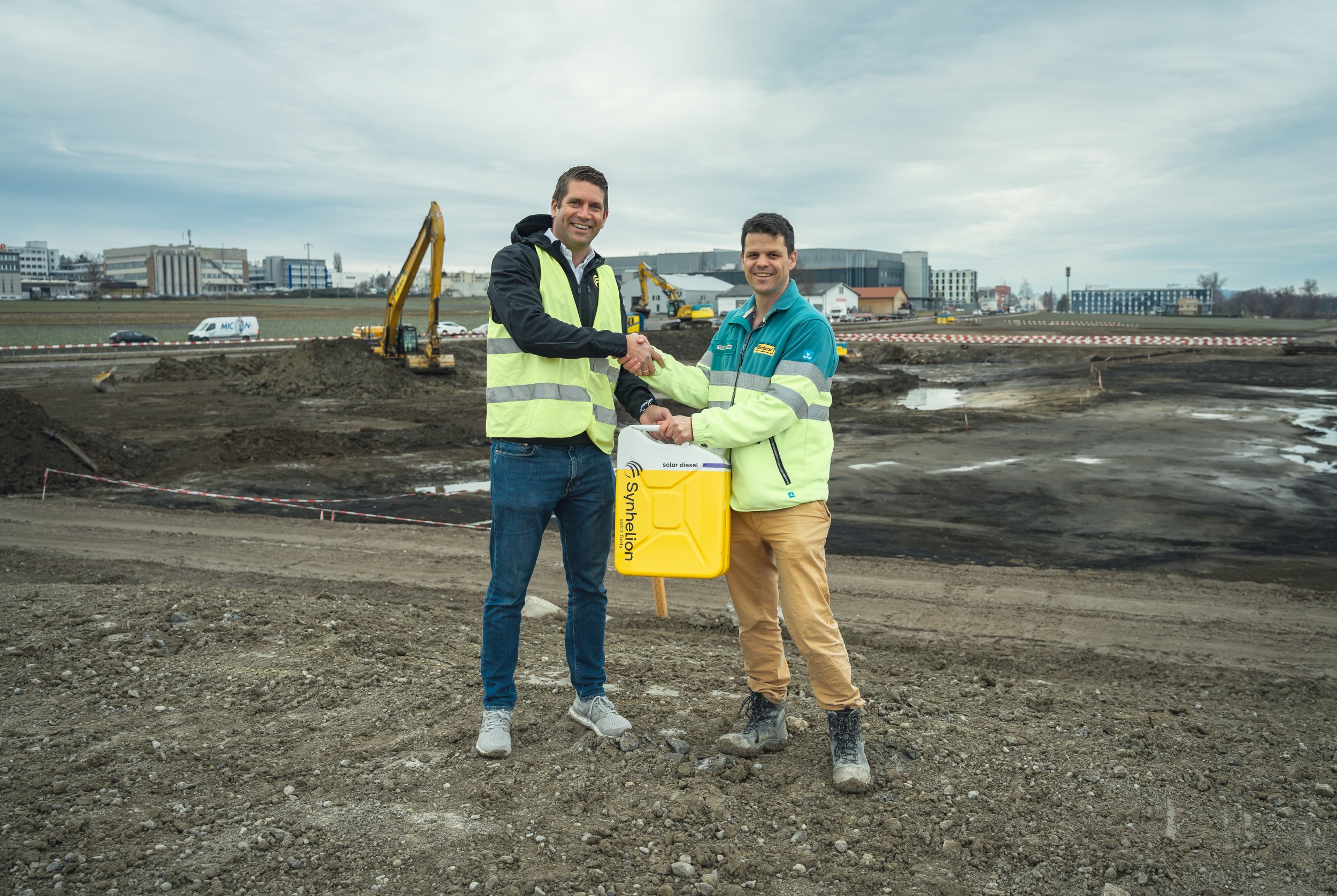
Today’s example from Switzerland illustrates how Solar-Power-to-X can support the defossilization of heavy-duty applications. The Swiss construction company Eberhard Bau AG has signed a long-term offtake agreement with cleantech company Synhelion for renewable synthetic diesel produced using solar energy. From 2027 onwards, Eberhard plans to use this fuel to reduce CO₂ emissions from its construction machinery.
Why Solar-to-X Matters for Construction and Industry
Construction equipment typically operates under demanding conditions, requires high energy density, and is often used in locations where charging infrastructure is limited. Fully electric solutions are therefore not always practical. Solar-to-X fuels offer an alternative: they can be used in existing combustion engines without modification and are compatible with today’s fuel infrastructure.
In this case, Synhelion’s solar diesel is produced using renewable energy and can reduce net CO₂ emissions by up to 100 percent compared to fossil diesel. This makes Solar-to-X fuels particularly relevant for heavy machinery and industrial applications where immediate emission reductions are needed without waiting for entirely new vehicle fleets.
Scaling Solar-to-X Technologies
Synhelion has already commissioned an industrial-scale plant for solar fuels and is preparing its first commercial facility, scheduled to start operations in 2027. The agreement with Eberhard marks the first application of Synhelion’s renewable fuels in the construction sector, complementing existing offtake agreements in aviation, shipping, and road transport.
This development highlights a broader trend: Solar-to-X is not limited to one sector but can support multiple parts of the energy system. By linking solar energy with fuels and molecules, StX helps bridge gaps where direct electrification is challenging, supporting energy security, climate targets, and industrial competitiveness.
Solar-to-X as a System Solution
As countries work towards climate neutrality, Solar-to-X is increasingly seen as a system solution rather than a niche technology. Its ability to store solar energy, transport it over long distances, and supply existing engines and infrastructure makes StX an important complement to electrification.
Real-world projects such as this offtake agreement show how Solar-to-X can already deliver tangible benefits today, while also laying the groundwork for a scalable, defossilized energy system tomorrow.
Source: Synhelion / Eberhard Bau AG press release, February 3, 2026.